How a $100million Course Left
Millions On the Table
A breakdown of Sam Ovens' Consulting Accelerator, and the fundamental ceiling of the course model.
Why analyze this course
If you don’t know, Consulting Accelerator was a six-week course by Sam Ovens on how to start and grow a profitable consulting business. He has since sold that company and works on Skool full time.
At the time, it was marketed with the goal of taking someone from beginner to their first high-paying client and a profitable business in 42 days.
So why look at this course specifically? Because it was a damn good course.
Based purely on content, you would be hard-pressed to find the same level of detail in any other course in the industry. It was, personally, the most complete information-based product I have ever purchased.
Call me biased, but I used this course to start a profitable marketing agency myself, so I can directly say the claim is accurate.
If we were to analyze a bad course, the holes are obvious and everywhere, so there’s not much to learn. But with a course that produced the results Consulting Accelerator had, there is a lot you can learn from and apply to your own course, digital product, or coaching program.
By the standards of this market, Consulting Accelerator was one of the strongest examples of the ceiling of the course model.
It was also not a pure information product. Sam believed content was not enough, so the experience was built around process, mental reprogramming, community, expert mentorship, tools, and metrics.
The most unique addition was the mental reprogramming piece, but the broader point is that the obvious support layers were already there.
We’ll look at why, even with all of the bells and whistles, this product is still severely missing the elements to get the majority of its customers the result they paid for.
The thesis
Even one of the best and most complete courses ever created still could not reliably get the average customer the promised result, because too much of the transformation remained dependent on the user’s judgment, behavior, and ability to execute in the real world.
That lack of control left massive customer and business value on the table
Content cannot describe every detail needed to execute each task.
It does not provide the tools for someone to actually change their behavior, even with the paradigm and worldview training. And it leaves too much of the transformation dependent on the individual.
So content, the foundational building block of every course, digital product, and coaching program, cannot reliably get the average customer results.
Does it happen? Sure. But that will always be a function of the user's motivation, judgment, discipline, and ability to figure things out, none of which you, as the business owner, have much control over.
That lack of control has a direct impact on the value of the business. If you could predictably get customers the result, more of them would pay more money for longer.
That changes lifetime value, and it changes the entire strategy of the business. The model most creators use is incapable of giving them that control. The rest of this report shows how Consulting Accelerator proves it.
Where the Course was Elite: Acquisition
Let’s start where Consulting Accelerator was an elite offering. The most obvious place was the progressive sequence for acquiring customers, which was the main thread through the first five weeks.
In most courses, acquisition was seen as a singular stage.
In Consulting Accelerator, it is more or less the entire course (we’ll talk about this idea later on).
Module 1
Module 1 is about setting your business foundations: picking your niche, offer, and business message. It should be obvious why it is first. How would someone start a business if they don’t have something to sell to someone?
Module 2
Then, module 2 is about the paradigm and worldview. Essentially, mindset training. This was an unusual cadence for online training at the time. Most in the online business world are aware of the usual mindset resources (Think and Grow Rich, The Secret, Psycho-Cybernetics, etc), but very few have had a complete or comprehensive philosophy outside of shallow explanations like “your thoughts control your reality.”
In Consulting Accelerator, Sam tried to leave no stone unturned and provide a complete framework (that was unique, I’d add.
But what does all of this have to do with acquisition? Remember, this is a course for beginners. If a beginner has never done something outside of their comfort zone, it is unlikely that just purchasing the course would be the catalyst to push them past their previously known ceiling.
So, put simply, this module is here to prepare them to do acquisition. You can dress it up anyway you like, but without it there would have been a larger percentage of people who never take action.
Module 3
Module 3 goes into the sales process, where the user learns about how to actually sell their services over the phone. The sales call, which is recommended to last from 45 minutes to an hour, takes the prospect through a journey so they can see the gap between where they currently are and where they want to go. And then at the end, the salesperson positions themselves as the vehicle to get the result the prospect wants. Like the earlier modules, this one is very thorough.
Module 4
The 4th module was probably the most practical and directly applicable content. All of the prep work from earlier weeks was to get to this point (over 40 hours of content in) where the user can go out in the real world and actually start marketing their services. Module one gave them the who, the what, and the how to communicate it. Module 2 gave the user the confidence to go out and actually do the acquisition tasks. Module 3 gave the sales process to convert into revenue. And now the climax is that they can actually make a sale with the module.
There was a massive amount of implementation-focused content in this section. This included instructions on how to set up your business, website, accept payments, create marketing assets, organic acquisition strategies, and more.
I remember thinking at the time I took the course, “Wow, is this all in one module?” It could have legitimately been a standalone course at the time.
Module 5
The acquisition arc caps off at module 5, where Sam goes deep into his Facebook ads strategy. Once you can acquire customers organically, it’s time to throw fuel on the fire with ads to acquire even more customers.
This was also a massive module at 24 groups of content. At the time, I thought this training was golden, but I didn’t really have the foresight. There are definitely some timeless principles of ads, but we’ll discuss the problems with this module later on.
Module 6
91 hours were focused on acquisition. The final module? 14 hours dedicated to delivering a minimum viable service to the customer. This includes setting client expectations, hiring, project management, and cash flow management.
Now let’s try to understand the course in more detail.
Analysis
Picking a Niche
Most courses give the same generic, vague advice:
Pick a niche.
Create an offer.
Go get clients.
But how do you actually execute on any of these?
Consulting Accelerator was different because it tried to remove as much guesswork as possible before the user ever spoke to the market.
For example, when picking a niche, the user had to narrow down their interests and skills, identify a painful problem worth solving, test the market to uncover what it actually wanted, shape that into an offer, and create a message that communicated the offer. Side note: This is essentially Dan Kennedy's marketing triangle. Then the user has to put that message in front of real people.
As we’ve already seen, every stage was incredibly detailed.
For a beginner, it could feel like all you had to do was watch the videos, follow the instructions, fill out the sheets, and the right decisions would be found formulaically. In this way, the acquisition process was treated almost like an assembly line.
But a factory-style approach still does not produce judgment. You would see this constantly in the group calls and community posts. Despite the implementation steps and worksheets, the same questions kept coming up. How do I know this is the right niche? Is this an offer my market actually wants? Is this a message that would resonate?
Sometimes the answer was basically “test it.” Other times, there was a direct answer explaining why something would or would not work. And that tells you something important: there is an underlying judgment being applied that cannot easily be extracted into a worksheet, because it is being applied to situations that keep changing.
Even when a course gives you all the seemingly right variables to pick a niche, it still is not easy for the average user. You can add all the points you want:
Do they have money?
Is the problem painful?
Do you have a channel to reach them?
Do they know they have the problem?
Are you interested in this industry?
Can you solve this problem?
But none of this accounts for the ever-changing market context: does that person want the thing you are offering in this very moment? That requires nuance, because the rules are always changing.
What someone wants tomorrow depends heavily on what they have heard today and have been hearing since yesterday. A worksheet will not help the user accurately pick a niche.
The obvious objection is that that is why you test and iterate. Yes, obviously. But picking the first iteration requires judgment. Knowing when and how to iterate requires judgment.
People can spend the rest of their business life randomly iterating from one thing to the next. Someone still has to judge the market, the problem, the timing, the message, and whether this is even worth building around.
So, despite the depth of the worksheets, the most important piece is missing.
The Master algorithm
Judgment is needed for the next two stages as well: creating the offer and the message. The same points about market timing and interpretation apply.
But there is another layer here. These components are iterative and require constantly returning to previously set hypotheses.
I have never seen this kind of process laid out so explicitly in any other training program, and it was brilliant.
The course is trying to push people to develop judgment. Whether it actually develops is another story, but the iterative process structure is a real attempt.
Sam called it the “master algorithm,” and he was right. You try things, see what works, and iterate.
So why does it break down? Because most people do not yet have the habits to follow the process long term. Even with the most descriptive information and a process designed to adapt to the ever-changing market, if the person does not build the habit of doing these actions, how likely are they to get the result they paid for? Not very likely.
How much content is too much?
After the foundational work, the course moves into gearing up less confident people to take action. Remember, these are beginners.
On average, even if someone understands what they are selling and who they are selling to, they are not simply going to go out and start making offers to the market. So the next progression is mindset, which makes sense given the 42-day goal.
No judgment is required to complete this portion, since the user defines what they want in their own life. What is required is watching 18 hours of content and understanding a new mental paradigm. For someone with a complex, time-crunched life, which is most people, why do they need to sit through that much content?
The behavior of doing mindset work for 20 minutes a day is more important than whether they understand every component of the philosophy.
One of the main problems with every product, especially digital, is getting people to use the thing as frequently as possible. Use case determines frequency.
Think Instagram versus TurboTax. For courses, that frequency needs to be multiple times a week. If someone only has an hour or two in each session, how does a three-hour abstract video help?
Having someone watch 18 hours of content before taking tangible action creates an almost obscene amount of friction, and that friction gets in the way of the exact action the result depends on, which is doing the mindset work daily.
The content was great, and week two was one of my favorite weeks of the course. But analyzing it objectively, entertainment value does not really influence the long-term behaviors the course is trying to build.
The Pitch Needs Judgement
The sales module follows the same pattern: heavy content up front, implementation steps near the end.
This time, the implementation requires judgment as the user builds their sales script. They need to clearly and concisely explain what their offer is and how it works.
There are infinite ways this could be delivered. Tonality, pacing, body language on video. Then there is the offer itself. When potential buyers say no, the user has to infer why it is not working.
Of course, this is part of the learning process. And for an information business that leaves results up to the user's motivation, then sure, the materials are enough. But remember the goal: start and grow a profitable consulting business, in a few weeks, while the habit of multiple new behaviors is still forming.
That is not a goal that static information alone can solve. And as I have covered in other work, it is not a problem that human support structures can reliably solve for the average student either. There are too many variables that the creator cannot control.
The sales module includes a tracking sheet, and calls are recorded. So it is true that, through iteration, a user might eventually stumble onto something that works. But how long will that take? It depends on far too many variables you have no control over.
The quality of the information only matters if the user can build the habits, repeat the behaviors, and make the right decisions for their specific situation.
Client attraction, and the self-diagnosis problem
The client attraction module was probably the best and most practical section of the course.
Most of it was implementation-heavy, and despite the long videos, the real substance lived in the cheatsheets attached to them.
After about 42 hours of content, this was the first time real-world execution became a central tenet of the course. Remember the promise: start a profitable business and get your first customer in 42 days.
But there is no clear path to actually do that, given the density of videos the user is told they must watch. After watching, they still need to complete the action items, which take a variable amount of time. If someone only had an hour a day, it would take more than 42 days just to finish the videos and the action items.
Visiting the doctor
One interesting addition was something Sam called “visiting the doctor and conquering paralysis,” a worksheet to help users who got stuck. Credit where it is due: this proves Sam understood that user problems vary and tried to solve them.
People get stuck for different reasons, and each case is slightly different. The sheet was essentially a decision tree, a chain of if-this-then-that. The vast majority of courses do not think this far.
But there is no way a decision tree can categorize every problem a user runs into. Most of the responses came down to “get back in the game,” “it's in your head,” or “you aren't motivated, so go drive Uber,” with a link.
The idea was great, but the execution does not really help the user. It also requires the user to categorize their own problem, and we are dealing with beginners. They may think they have one issue when it is something else entirely.
Which raises the question: what is wrong with self-diagnosis? How many times have sick people misdiagnosed their own health concerns? That is why you go to the doctor. They diagnose you because, in many cases, you are incapable of doing it alone.
So even if you added more decisions and more leaves to the tree, the user would still have to do the classification themselves, which is the exact thing they cannot reliably do.
Static content yet a moving target
The last step of the acquisition arc was the paid ads section. From a content perspective, it could be its own course. It is a beast, 24 hours on its own. During the course's heyday, some people said this section alone was worth the price.
Maybe that was true for a frozen moment in time.
But the problem with any platform-specific training is that the platform is always changing. A course created around 2016 or 2017 is supposed to reflect how the platform operates at the point of sale. That is impossible.
A clear example: around 2020, Facebook made Campaign Budget Optimization mandatory. That decision was short-lived due to advertiser backlash, but Consulting Accelerator taught a strategy based on ad-set budget optimization, so the strategy was suddenly outdated.
More recently, the Andromeda update to Meta's ad auction caused similar chaos that people are still working through.
This is probably the single best demonstration of the fundamental limitation of static content as the building block of a product.
The environment changes constantly, and the only way to update static content is to completely revamp it, which takes time. Despite marketing promises to keep courses updated, they very rarely are because it is a lot of work.
The best information-based version of this would be a core set of videos based on principles that do not change, plus short modules for the specific implementation steps that change all the time. That is still incomplete because it is still static, but it would be better than the current norm.
And even here, judgment is still required for the daily ad tracking.
The videos give the user KPIs to track, but that does not remove interpretation. You still have to evaluate what the numbers actually mean and decide what to do next. It is not a one-to-one relationship where you read the sheet, and the answer is obvious. There is nuance in the data, so judgment is required even for the tracking itself.
Acquisition was systematized, delivery was not
Here is where it gets interesting. The entire course is about 105 hours. Fourteen of those hours are allocated to the final module: Minimum Viable Service Delivery. That is the delivery of the very services the rest of the course taught the user to sell.
Put that in perspective.
The first five modules, fundamentals, mindset, sales, client attraction, and Facebook ads, are the vast majority of the course. That is 91 hours, nearly 100, not including the actual work the user has to do.
And even the mindset material, you could argue, is still in service of acquisition; Sam mentions that people need to get comfortable outside their comfort zone so they can do sales calls and work hard.
Look at the client attraction module's warm-up calendar, and the majority of the actions are acquisition activities.
So by the time you reach module six, Minimum Viable Service Delivery is just a small sliver of the whole course. The majority of the time is spent on getting a client, not on actually delivering anything for that client.
And why is that? Probably because there is going to be variance in every unique delivery situation. Sam gives a watered-down, generalized version of delivery: cut the fat, hire good contractors, manage cash flow, use these project-management workflows.
Those are general topics. There is not much specific instruction on how you actually deliver the result. This is why so many people struggle with delivery after this course.
They do not come out with a real model for doing it.
I understand why it is not included in static content. I am not saying it is easy to include. I am saying it is a massive hole. How do you actually manage the project?
That is critical, and it is not in the course.
They systematized the hell out of everything related to getting the customer. But look at what Consulting Accelerator gives you to actually deliver the result: almost nothing. An intake form, a dummy contract that says results are not guaranteed, and a worksheet that says figure out what you are good at and hire out the rest. So the entire course is about acquisition. It is not really about how to maintain and deliver in the business.
This is the limitation of static courses, stated plainly. Static courses can cater to the broad, assembly-line parts of the system, the parts common to everyone. But they cannot cater to the unique individual situations inside that system. And that is needed for delivery more than any other part of the course
What a fix could look like
So how would you actually fix these problems, and what would that look like in an application?
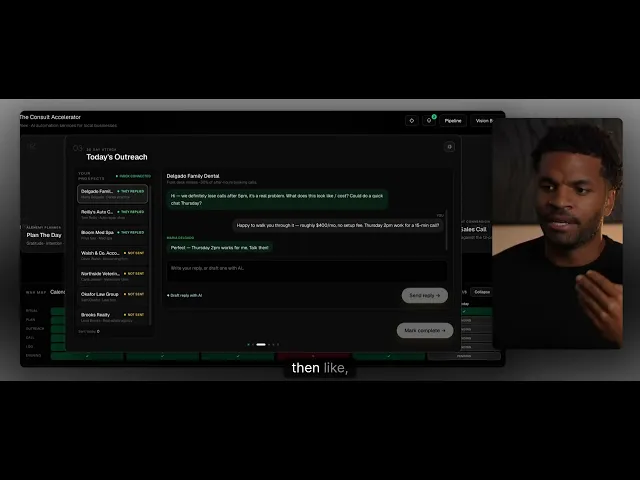
What follows is a demo. It is not a fix for every individual problem raised in this report, and it is not a production system. It was put together quickly as a proof of concept.
The goal is to get your creative juices flowing about how you might solve similar issues in your own product.
Get the user to real-world action as fast as possible
The default path to the outcome should be real-world action, with video content added only where necessary. The solution in-app is a daily habit loop: everything the user needs to execute that day to move closer to the outcome. Some of it is habitual, like mindset twice a day, tracking KPIs, and a to-do list, and some is specific to the phase the user is in. The demo includes an integrated outreach system, a sales-call simulator for practice, and a sales-call feedback system, all tied to the client acquisition stage.
Build in places to develop judgment
The user needs to catch on to the nuances of the method. Since Sam cannot sit with everyone individually, these are the places to combine deterministic software with controlled AI outputs to give the user feedback on the method. Again, this is a demo meant to convey the idea, not a finished product.
Delivery: the biggest open opportunity
One thing not built into the demo is a delivery solution. This was the weakest part of the course precisely because it was so acquisition-focused. Generalized software with deterministic rules that enforce guidelines and standards for client delivery would be the ultimate solution.
Exactly how that works needs to be fleshed out, but it is a real opportunity, especially since there are already many tools for the client-management side.
Other features included to round out the experience: a sales pipeline tracker, a vision board, in-app daily reviews, and a war-map-style calendar to more closely mirror the structure of Consulting Accelerator.
The business case
We spent all this time on the mechanics of Consulting Accelerator, but why does it matter? Because you are running a business, one of the biggest indicators of a valuable business is customer economics.
Specifically, the LTV: CAC ratio, which is how much a customer spends with you versus what you paid to acquire them. The quality of that revenue matters too, because one-off purchases are far more exposed and volatile than repeat purchases.
So, how do you increase LTV: CAC and get predictable repeat purchases? In most businesses, the path is clear: create a good product or service, deliver the outcome, and people buy again because you delivered. That is technically true for information-based products as well, except that these businesses have much less control over whether someone actually gets the outcome. In other business types, the product or service itself delivers the outcome, so there is control.
Why the difference? Because even if you deliver the best information, the best frameworks, the best SOPs, the user still has to go out and implement all of it themselves.
We cannot rewind the clock and rebuild Consulting Accelerator today. But this teardown gives you the thought process for how to evaluate and then solve these same problems in your own business.
Because at the end of the day, you are in the business of behavior change, not information delivery, and the products and services you build need to be held to that standard.
This awareness is the first step. If you would like help doing this for your specific business, the next step is to get in touch.